Executive Summary
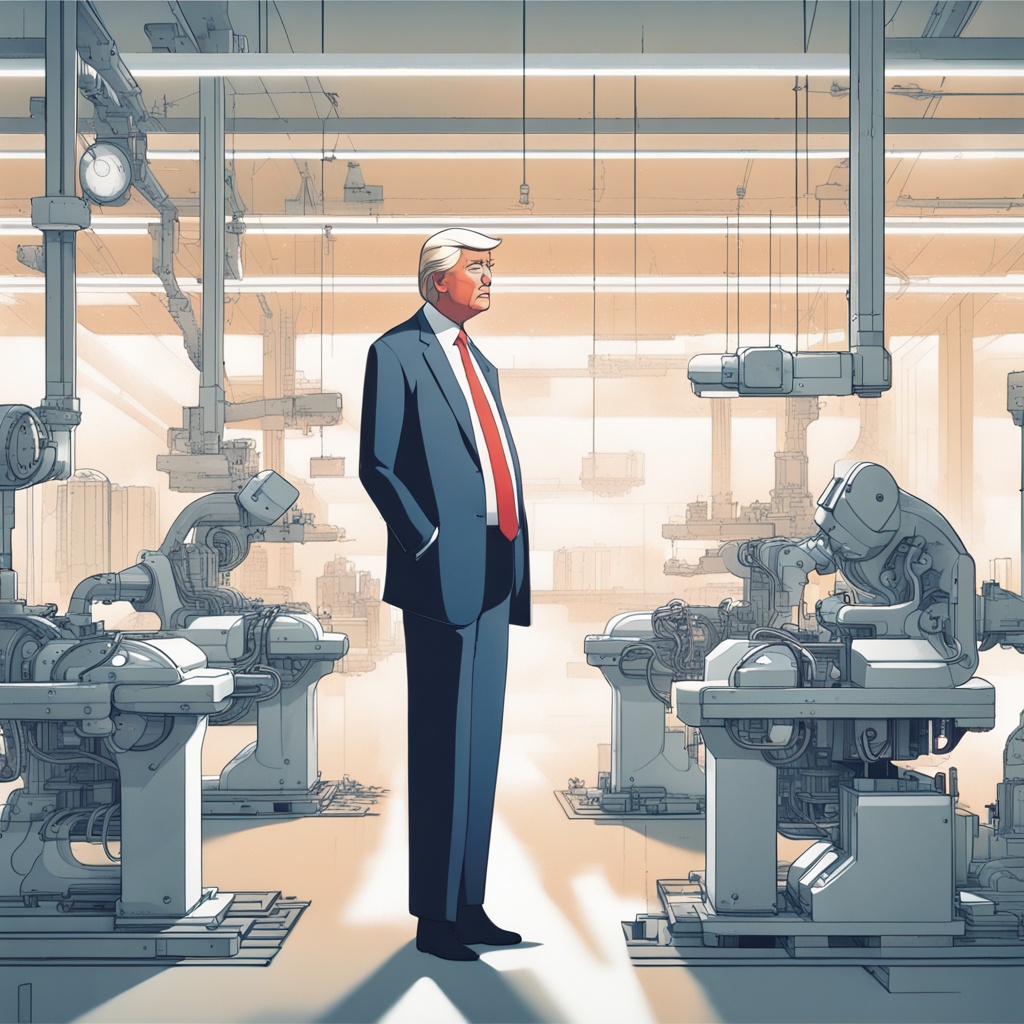
President Trump's newly announced tariffs on imports from major trading partners have been pitched as a strategy to revitalize American manufacturing and bring jobs back to states like Michigan. However, a careful analysis of economic incentives, technological trajectories, and business decision-making suggests these tariffs may instead accelerate the adoption of artificial intelligence and robotics in manufacturing—potentially eliminating more jobs than they create. With AI capabilities advancing rapidly since Trump's previous tariff experiment in 2018, businesses facing higher labor costs in the U.S. may find automation more economically attractive than hiring American workers.
The Automation Incentive
The fundamental economic principle underlying manufacturing location decisions is cost-benefit analysis. When labor costs are low—as they are in countries like Vietnam or Mexico—companies have little incentive to invest in expensive automation technologies. The human worker remains the more economical option. However, when those same companies face significantly higher labor costs in the United States, the calculus changes dramatically.
"There's no reason whatsoever to believe that this is going to bring back a lot of jobs," Carl Benedikt Frey, an economist and professor of AI & work at Oxford University, argues in the TIME article. "Costs are higher in the United States. That means there's an even stronger economic incentive to find ways of automating even more tasks."
This observation aligns with research from the McKinsey Global Institute, which has consistently found that automation adoption correlates strongly with labor costs. In their analysis of manufacturing economics, when labor costs rise by 20% or more, the return on investment for automation technologies improves significantly, often justifying the substantial upfront capital expenditure.
While the White House portrays tariffs as a mechanism to force manufacturing reshoring, the more likely outcome is what economists call "substitution"—replacing one input (foreign labor) not with domestic labor but with technology (automation).
The AI-Robotics Technology Leap
What makes the current tariff scenario particularly consequential is the dramatic advancement in AI and robotics capabilities since Trump's previous tariffs in 2018. These technological leaps fundamentally alter the automation equation for manufacturers.
In 2018, industrial robots were largely limited to performing repetitive tasks in controlled environments. They excelled at welding car frames and lifting heavy components but struggled with tasks requiring dexterity, adaptability, or judgment. This technological limitation preserved many manufacturing roles for human workers, even in high-wage economies.
The current generation of AI-enhanced robotics represents a quantum leap in capabilities. As noted by Lucas Hansen of CivAI, "It doesn't require much special effort to apply robots to new purposes now, especially once this technology matures a bit more. So if you're a mid-sized manufacturing operation, previously you would have had to invest tons of money in R&D to automate everything. But now, it will require a lot less marginal effort."
This technological transformation is reflected in manufacturing automation investments. According to the International Federation of Robotics, global industrial robot installations have increased by approximately 40% since 2018, with the most sophisticated AI-enabled systems growing at even faster rates. The combination of large language models providing more flexible "robot brains" and advances in mechanical systems has created automation solutions that can now address a much wider range of manufacturing tasks.
Short-Term Disruption vs. Long-Term Transformation
The timing and impact of tariff-induced automation won't be immediate. As Nobel Prize-winning economist Daron Acemoglu notes in the TIME article, the immediate effect of tariffs will be economic disruption, during which few companies will make major capital investments. Additionally, tariffs themselves may increase the cost of importing automation equipment, creating a temporary disincentive.
However, economists project that if tariffs persist into the medium term (2-3 years), companies "will have no choice but to bring some of their supply chains back home—but they will do it via AI and robots," as Acemoglu told TIME.
This pattern aligns with historical manufacturing transformations. When Japanese auto imports faced restrictions in the 1980s, Japanese manufacturers responded not by creating massive numbers of American assembly line jobs, but by establishing highly automated production facilities in the U.S. that employed fewer workers than their counterparts abroad. Toyota's Georgetown, Kentucky plant, opened in 1988, became a model of lean, partially automated manufacturing that produced more vehicles per worker than most traditional facilities.
Case Study: Automotive Manufacturing Automation
The automotive industry provides a clear window into how tariffs might accelerate automation rather than job creation. When BMW expanded its Spartanburg, South Carolina plant in 2014, the company invested $1 billion but added only about 800 direct jobs—approximately $1.25 million in capital investment per job created. This reflected BMW's strategy of building highly automated facilities when operating in high-wage environments.
More recently, Tesla's approach to manufacturing demonstrates the automation trajectory likely to accelerate under tariffs. Tesla's Gigafactory in Nevada and other facilities were designed from the ground up to maximize automation. While Tesla initially struggled with what CEO Elon Musk called "automation hell" when trying to ramp up Model 3 production, the company has since refined its approach to blend strategic human involvement with extensive automation.
A telling comparison comes from examining production worker counts in automotive manufacturing. According to Bureau of Labor Statistics data, U.S. automotive manufacturing employed approximately 1 million workers in 2000, producing about 12.8 million vehicles. By 2023, despite similar production volumes, employment had fallen to about 740,000 workers—a 26% reduction achieved primarily through automation.
If tariffs force more automotive production back to the U.S., the industry's established pattern suggests companies will follow Tesla's example rather than returning to labor-intensive production methods of decades past.
The Foxconn Precedent
Perhaps no case study better illustrates the gap between political promises of manufacturing job creation and the automation reality than Foxconn's Wisconsin project.
In 2017, the Taiwanese electronics manufacturer announced plans to build a massive LCD manufacturing complex in Wisconsin, with then-President Trump heralding it as "the eighth wonder of the world" that would create 13,000 manufacturing jobs. The state of Wisconsin offered $4 billion in tax incentives based on these job creation promises.
What actually materialized was starkly different. By 2021, Foxconn had scaled back its plans dramatically, built a much smaller facility, and created fewer than 1,500 jobs—many of which were in engineering and technical roles rather than traditional manufacturing positions. Most tellingly, the company shifted its focus from labor-intensive assembly to developing automated manufacturing solutions.
Foxconn's experience demonstrates a crucial reality: when Asian manufacturers consider U.S. production, they generally plan for highly automated facilities rather than labor-intensive operations. Tariffs may change where products are made, but they rarely reverse the fundamental economics that drive automation.
Technological Limitations: What Can and Cannot Be Automated
Despite advances in AI and robotics, significant technological barriers to complete manufacturing automation remain. As Acemoglu notes in the TIME article, robots "still struggle in complex environments, even if flashy corporate demo videos suggest otherwise." He predicts truly flexible robotics solutions are at least a decade away.
The MIT Task Force on the Work of the Future provides a more nuanced view of automation's capabilities and limitations. Their research indicates that tasks requiring complex physical manipulation, expert judgment, creative problem-solving, and interpersonal skills remain difficult to automate economically. Manufacturing processes involving irregular materials (like textile manufacturing) or requiring fine adjustments still benefit from human capabilities.
However, these limitations are narrowing rapidly. Research from Boston Consulting Group indicates that the cost of advanced robotics systems has fallen by approximately 50% over the past decade, while capabilities have expanded significantly. AI systems can now handle quality control inspections that previously required human judgment, and collaborative robots can work alongside humans in less structured environments.
Economic Impact: The Productivity-Employment Tradeoff
If tariffs do accelerate manufacturing automation, what would this mean for the broader economy? Stanford economist Erik Brynjolfsson, quoted in the TIME article, warns that the "main first-order effect of tariffs is they will make everything less efficient. When you throw sand in the gears of supply chains and global trade, we're all just going to be a little bit poorer."
This economic drag from supply chain disruption could be partially offset by productivity gains from automation, but historical evidence suggests these gains rarely translate into equivalent employment growth. The Peterson Institute for International Economics found that previous rounds of tariffs led to higher prices for American consumers and businesses while creating minimal job growth in protected industries.
A more optimistic perspective comes from manufacturing regions that have successfully navigated automation transitions. In Germany's manufacturing heartland, extensive factory automation has coincided with relatively stable employment through a combination of workforce retraining, education system alignment with industry needs, and strategic government-industry partnerships focused on creating higher-skill manufacturing roles.
The German model suggests automation driven by tariffs need not destroy manufacturing employment entirely, but it requires deliberate policies to manage the transition—policies that currently appear absent from the tariff strategy.
Historical Patterns: Automation During Economic Uncertainty
Labor historian Brian Merchant, quoted in the TIME article, highlights another concerning pattern: "Historically when there is a downturn, if there is an opportunity to automate, then companies will take it. That doesn't necessarily mean that you'll use fewer humans, but it does mean that employers have a chance to break through labor protections and gain more leverage."
This observation is supported by research from the National Bureau of Economic Research, which found that automation investments typically spike during and immediately following economic downturns. The 2008-2010 recession saw manufacturing firms increase automation investments by approximately 30% compared to pre-recession levels as they sought to emerge with more flexible, less labor-dependent operations.
Tariff-induced economic disruption could trigger a similar automation response, particularly as C-suite executives increasingly view AI and robotics as strategic imperatives rather than optional enhancements.
The Policy Contradiction
The current administration appears to hold contradictory positions on automation and employment. As the TIME article notes, Vice President JD Vance has stated: "We refuse to view AI as a purely disruptive technology that will inevitably automate away our labor force. We believe and we will fight for policies that ensure that AI is going to make our workers more productive, and we expect that they will reap the rewards."
Yet this aspiration fundamentally conflicts with the economic incentives created by tariffs, which make automation more attractive relative to human labor. Without specific policies to ensure productivity gains benefit workers—such as profit-sharing requirements, training guarantees, or stronger labor protections—the natural business response to tariffs will be maximum automation with minimum employment.
The contradiction reveals a deeper misunderstanding of modern manufacturing economics. In globally competitive industries, companies facing significantly higher labor costs must either automate extensively or lose market share to competitors who do. Tariffs alone cannot change this reality; they can only change where automation occurs.
**Strategic Alternatives**
If the goal is genuinely to increase manufacturing employment in the United States, alternative approaches would likely prove more effective than broad tariffs:
- Targeted industry policies that combine reshoring incentives with employment requirements, similar to programs in countries like South Korea and Singapore that have maintained manufacturing employment while embracing automation.
- Manufacturing workforce development programs that create skilled workers capable of programming, maintaining, and working alongside advanced manufacturing technologies—addressing the actual skills gap in modern manufacturing.
- Research and development investments focused on manufacturing technologies that augment rather than replace human capabilities, following the collaborative robotics model pioneered in Denmark and Germany.
- Trade agreements with labor standards that level the playing field without disrupting supply chains, reducing the labor cost differential that drives both offshoring and automation.
- Regional manufacturing innovation hubs that build ecosystems of suppliers, skilled workers, and technology providers capable of supporting competitive manufacturing without extreme automation.
These approaches acknowledge the reality that manufacturing competitiveness in high-wage economies depends on strategic advantages beyond simply cheap labor—advantages like workforce skills, innovation ecosystems, and supply chain integration.
Implications for Business Leaders
For business leaders navigating this shifting landscape, several strategic considerations emerge:
- Automation investment timing: While tariffs may initially discourage capital investment due to economic uncertainty, companies should develop medium-term automation strategies that anticipate both tariff persistence and technological advancement. The window between tariff implementation and full automation capability represents a critical planning period.
- Workforce transformation: Rather than viewing the tariff-automation dynamic as binary (jobs vs. robots), forward-thinking manufacturers should develop transition strategies that retrain existing workers for the higher-skill roles that emerge alongside automation. Companies like Siemens have demonstrated that worker upskilling can proceed in parallel with automation deployment.
- Supply chain redesign: Tariffs necessitate supply chain reconfiguration regardless of automation decisions. Leaders should evaluate reshoring, nearshoring, and automation options as an integrated strategy rather than separate considerations, recognizing that optimal solutions may combine elements of each approach.
- Technology partnership strategy: The AI and robotics capabilities needed for cost-effective automated manufacturing typically exceed in-house capabilities for all but the largest manufacturers. Strategic partnerships with technology providers, research institutions, and systems integrators will prove crucial for successful implementation.
- Regulatory engagement: Business leaders should actively engage with policymakers to shape how tariffs and automation policies intersect. The German industry associations' collaborative approach to Industry 4.0 policy development offers a model for productive public-private coordination around manufacturing transformation.
Conclusion: The Automation Acceleration
President Trump's tariffs aim to revitalize American manufacturing employment, but economic incentives and technological trajectories suggest they may instead accelerate the replacement of human workers with increasingly capable AI and robots. The combination of higher domestic labor costs and advancing automation capabilities creates a powerful incentive for companies to automate rather than hire.
This doesn't mean manufacturing will disappear from America—it may well return in some sectors. But the manufacturing that returns will likely be highly automated, creating far fewer jobs than politically promised and requiring very different skills than the manufacturing jobs of the past.
The historical evidence, economic logic, and technological trends all point toward the same conclusion: in a global economy where companies can choose between high-cost labor, low-cost labor, or increasingly capable automation, tariffs that eliminate the low-cost labor option will primarily benefit the machines.
Business leaders and policymakers would be better served by acknowledging this reality and developing strategies that help workers and communities navigate the transition rather than promising a manufacturing employment renaissance that automation economics make increasingly unlikely. The future of American manufacturing lies not in turning back the clock, but in creating new models of production that can succeed in a high-wage, technology-intensive environment.
For an in-depth exploration of how tariffs and automation interplay, consider reading more in this TIME article.